Crossing the High Atlas
The Tizi n'Tichka pass at about 2,260 m, with snow on the peaks in winter.
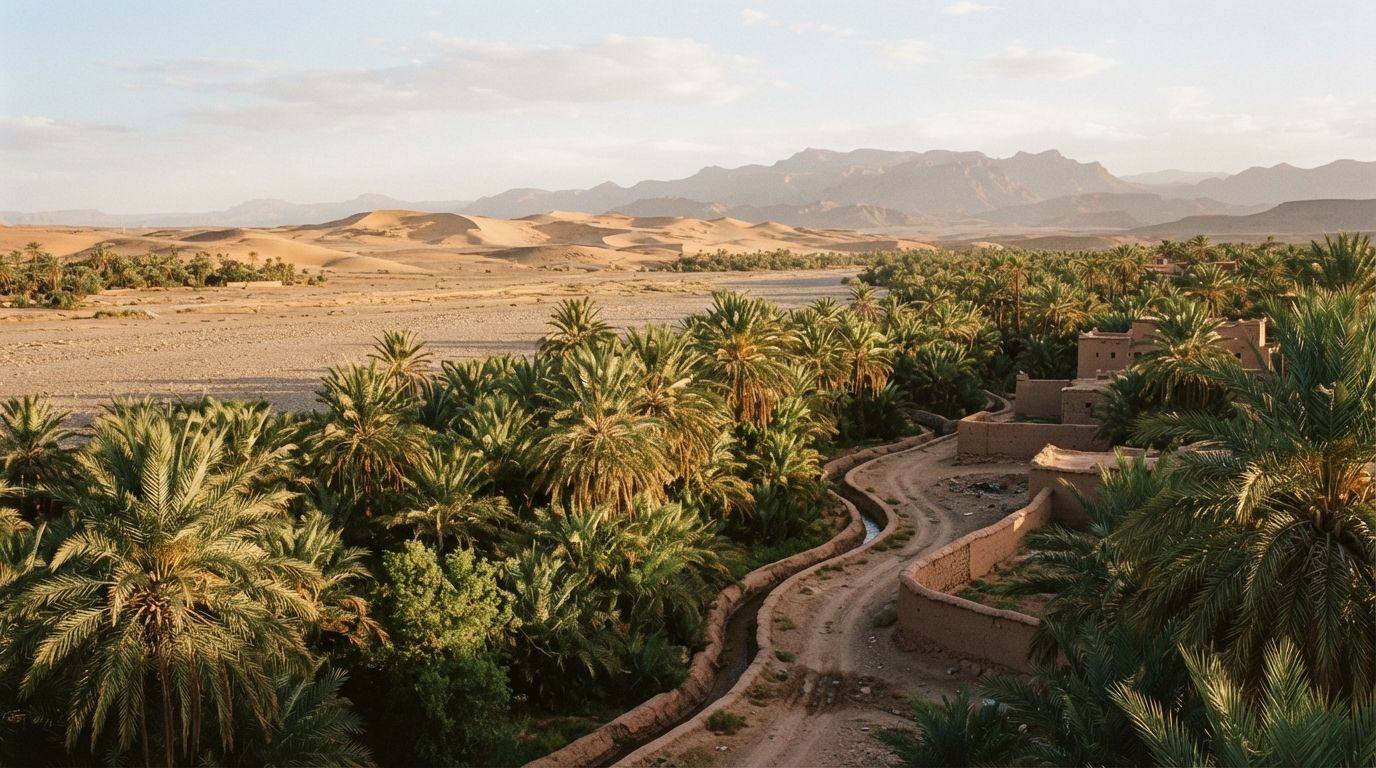
2 days · 1 night · 350 km from Marrakech
Zagora is the nearest real sand to Marrakech. Getting there means crossing the High Atlas and following the Drâa valley south, and that drive takes up most of the trip.
AI-generated illustration
Book this trip
Zagora, 2 days
Tours from €68 per person
Price per person read on Civitatis on 21 October 2026. How we pick and order tours
Short answer
A Zagora desert trip from Marrakech takes two days and one night: about 6–7 h of driving each way over the Tizi n'Tichka pass and down the Drâa valley, then a sunset, a camp night and a sunrise. The dunes are real but small. Choose it if you have exactly two days; with three, Merzouga's dunes are far bigger.
Choose Zagora if you have two days and want a night in a desert camp with some sand around it.
Think twice if tall dunes are the goal, or if two long days in a minibus sound worse than one night in Agafay.
The route climbs the High Atlas to the Tizi n'Tichka pass, at about 2,260 m, then drops to Ouarzazate and follows the Drâa valley past Agdez to Zagora. Expect hairpins, a few photo stops and lunch on the way.
Most two-day tours stop at the ksar of Aït Ben Haddou, a UNESCO World Heritage site since 1987. The Drâa valley palm groves and the old kasbahs along them are, for many people, as good as the dunes. If that sounds dull to you, Zagora is the wrong trip.
The sandy areas around Zagora, mainly towards Tinfou and Erg Lihoudi, are small dune fields set in stony plain. You can walk up a dune, watch the sunset from it and sleep beside it, but you will not see sand to the horizon.
Camps vary a lot. Some sit right in the dunes, others on gravel a short walk away. Ask for the camp's area or name before booking, because a generic dune photo tells you nothing about what is outside your tent.
Category names mean different things to different operators. Rather than trust the label, check the facts you can verify: a bathroom inside the tent or shared blocks, the type of bed, whether tents are shared with strangers and whether there is a single supplement.
Desert nights are cold from November to March. Ask about heating or extra blankets, and pack a warm layer anyway.
Zagora is known for its sign reading Tombouctou 52 jours, the camel-caravan time to Timbuktu. The sign you see today is the famous one or its replica, as the original has been repainted and replaced over the years. Tours often stop there for a photo on the way to camp.
If big dunes are why you are going to the desert, find a third day and go to Merzouga. The extra day buys you Erg Chebbi, a far larger erg, with a night in the Dades area on the way.
If you cannot find that day, choose Zagora for what it is: the Atlas, the Drâa valley and a night in camp. Our Merzouga guide and two days from Marrakech set out the trade-off.
Day 1
Early departure, the Tichka pass, a stop at Aït Ben Haddou and the drive down the Drâa valley. Arrival near Zagora in the late afternoon.
Night
A short camel ride or walk to the dunes for sunset, dinner and a night in the camp. Check which meals and activities are included.
Day 2
Sunrise on the dunes, breakfast, then 6–7 h back through Ouarzazate and over the Atlas. Arrival in Marrakech in the evening.
The Tizi n'Tichka pass at about 2,260 m, with snow on the peaks in winter.
Long strips of date palms and earth kasbahs along the river.
Darker skies than the city and a sunrise over small dunes.
Yes, but small ones. The dune fields near Zagora are modest patches of sand in a stony landscape. For tall dunes you need Erg Chebbi near Merzouga.
Technically, but it means 6–7 h of driving each way and almost no time in the desert. The usual tour is two days and one night, and that is the minimum we would plan.
With two days, Zagora. With three or more, Merzouga, because the dunes are on a completely different scale. Both include a long drive over the Atlas.
About 350 km, which takes 6–7 h without long stops. With the usual photo, lunch and Aït Ben Haddou stops, the first day is a full one.
On Civitatis, the two-day Zagora tour starts at around €68 per person. The price changes with season and camp category, and drinks and lunches are usually extra.
Spring and autumn are the most comfortable. In July, Zagora's average high is about 45 °C, while January nights fall to about 4 °C, colder in an open camp. See when to go for each month.
Also from Marrakech
Merzouga, 3 days
Tours from €109 per person
Private desert trip, 2 to 4 days
Price per person read on Civitatis on 21 October 2026.
Reviewed: